


Vultures may not be the most glamorous or beloved birds in the animal kingdom, but their importance is undeniable and their abilities truly remarkable.
Often misunderstood, these scavengers play a crucial role in maintaining ecological balance by efficiently disposing of carrion, thereby preventing disease from spreading.
From their astonishingly acidic stomachs to their impressive soaring capabilities, we’ll delve into this curious, and somewhat strange, group of birds known as vultures.
Let’s get into it.
Vultures Are Divided Into Two Families

Vultures are found on every continent except for Antarctica and Australia.
There are 23 vulture species divided into two families: 1) Old World vultures (Accipitridae) found in Africa, Asia and Europe, and 2) New World vultures (Cathartidae) that live in North America and South America.
Interestingly, Old World and New World vultures are not closely related despite looking similar.
This is due to convergent evolution, which means Old World and New World vultures evolved the bald head and carrion eating traits independently.
But, one key difference is that Old World vultures lack the acute sense of smell that New World vultures use to locate a meal.
Vulture’s Do Not Sing

Vultures are unable to produce notes and vocalizations the way a songbird can because they lack a syrinx (a bird’s voice box). But, vultures can make simple sounds like grunts and hisses, which they use to communicate with each other.
In fact, griffon vultures have a surprisingly sophisticated set of vocalizations for social interactions, a trait recently revealed by studies.
With a range of twelve different calls, their vocal repertoire rivals or even surpasses other species of birds known for their complex vocal communication.
The study found that vultures were able to make these vocalizations:
- Metallic Groan
- Grunt
- Bray
- Quacking
- Hiss
- Groan
- Sharp Scream
- Small Groan
- Bray Hiss
- Chicken Groan
- Chicken Coo
- Juvenile Scream
Vultures Eat More Than Carrion
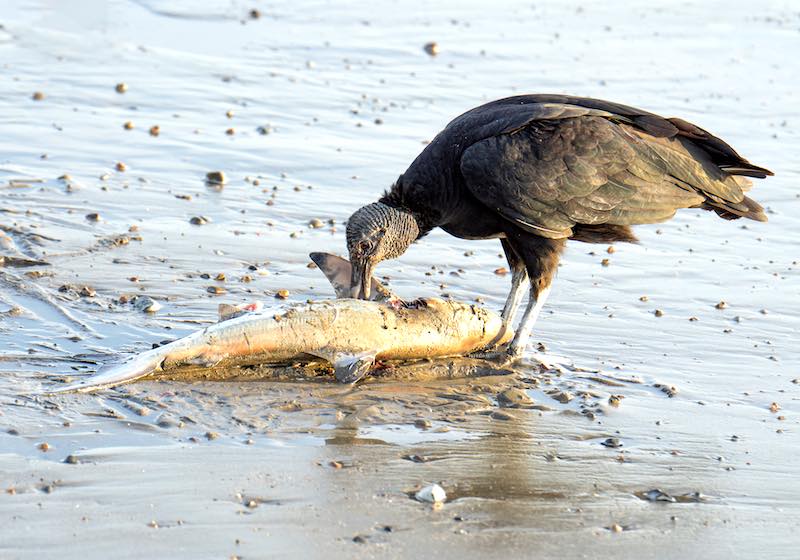
Despite their notorious reputation as scavengers, not all vultures are strictly carnivorous.
For instance, both the palm nut vulture and the lappet-faced vulture have shown preferences for a more varied diet.
They feast on an array of foods such as nuts, fish, and other birds, thereby defying the stereotype of vultures being exclusively carrion feeders.
Interestingly, a vulture’s digestive system is equipped with extremely strong acids.
These acids serve a dual purpose: they help combat and destroy harmful bacteria and also aid in breaking down the bones, which make up 70-90 percent part of a vulture’s diet.
Vultures Pee on Themselves
Vultures have a unique way of cooling down their bodies and disinfecting themselves after feeding.
They engage in a process known as ‘urohydrosis’, where they urinate on themselves.
This technique helps lower body temperature when faced with scorching heat and also helps kill off any bacteria on their legs post feeding, thanks to the high acid content of their urine.
Vultures Do Not Have a Sixth Sense
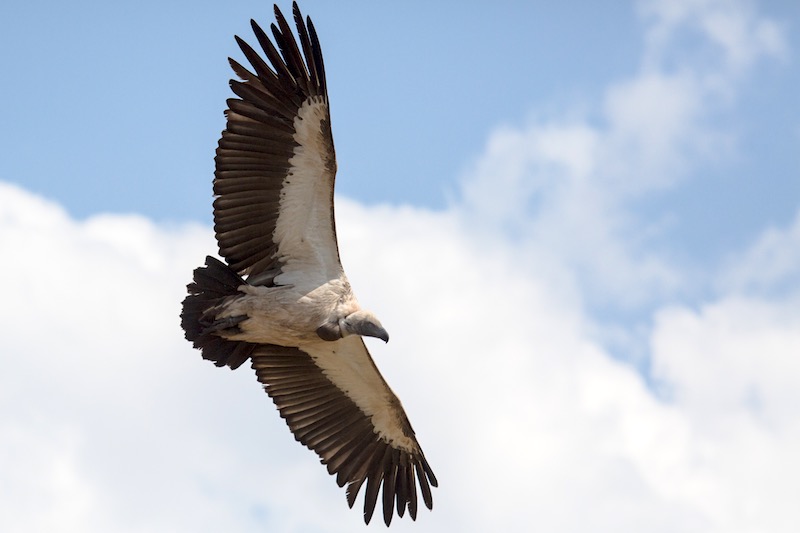
Contrary to popular belief, most vultures do not have a sixth sense for identifying or detecting dying animals.
Instead, most vultures rely on visual cues to spot other birds and animals feeding on a carcass, leading them to their next meal.
This is particularly evident with the bearded vulture, which waits for wolves to finish their meat before swooping down to consume the leftover bones.
Interestingly, the turkey vulture has a more developed sense of smell than other vultures and can locate a carcass by smell from over a mile away (1.6 kilometers).
Contrary to popular belief, vultures do not circle in the air to wait for their prey to die.
Their circling flight pattern is a way to leverage rising hot air thermals, enabling them to gain height and soar over long distances without having to flap their wings.
This energy-efficient method is crucial for these scavengers to locate their sporadic food supply.
The circling behavior of vultures is a part of their food-finding strategy, it allows them to safely survey the area below and locate a dead animal.
Interestingly, turkey vultures have a more developed sense of smell than other vultures and can locate a carcass from a surprising distance.
Vultures Can Fly Higher Than Other Birds
Vultures possess unique cardio-vascular adaptations enabling them to fly at heights where oxygen levels are at their thinnest.
This capability allows them to soar in thermals (warm rising air currents) to reach heights deadly to other bird species.
One particular species, the Ruppell’s griffon vulture, has been documented at a height of over 6.84 miles (11 kilometers), which is the record for highest flying bird.
Vulture Are Adaptable

A characteristic feature of many vultures is a bald, unfeathered (or lightly feathered) head, which assists in keeping the head clean when feeding and plays a vital role in thermoregulation.
Vultures engage in a variety of behaviors to adapt to their environment. They hunch their bodies and tuck in their heads in cold weather, and spread their wings and stretch their necks when it’s hot.
Vultures Are Loyal
Vultures usually mate for life, returning to the same partner every breeding season.
The courtship of turkey vultures begins with a group hopping dance, after which pairs couple off and fly in tandem.
Vultures typically lay two eggs that both parents incubate for approximately 28 to 40 days.
The chicks are born blind and helpless, developing their wings between nine to 10 weeks and leaving the nest around 60 to 80 days.
Vultures Prevent The Spread of Disease
Vultures play a crucial role in the ecosystem, preventing the spread of diseases by consuming decaying bodies.
Their stomach acid not only allows them to consume rotten food safely but also destroys potentially harmful bacteria, curbing their spread.
By “cleaning up” remains, they prevent unpleasant odors, reduce carbon emissions, and keep bacterial threats such as botulism and plague at bay.
While vultures may often be associated with unsavory images, their significance in the ecosystem is undeniable.
In fact, in Latin, the word “vulture” means to pluck or tear, while their scientific name, Cathartes aura, translates to “golden purifier” or “purifying breeze,” aptly highlighting their role as a cleanup crew.
Vultures Eat More Than Carrion
Vultures’ dining habits extend beyond the realms of carrion.
For instance, the palm-nut vulture of coastal central Africa primarily consumes fruits of raffia and oil palms, while Egyptian vultures are known tool users, employing rocks to break tough ostrich eggs.
The bearded vultures prefer the bones of animals like goats and other small ungulates, which they drop from the sky onto rocks to expose the nutritious marrow within.
Check out this video of an Egyptian vulture breaking open an egg with a rock:
Vultures Have a Unique Defense Mechanism
Vultures have a unique way of defending themselves.
In the face of a threat, they practice defensive vomiting, a behavior designed to discourage would-be attackers.
They rely on the unappealing nature of their vomit and the surprise factor to deter predators and buy time to escape.
Vultures Have Memorable Collective Nouns
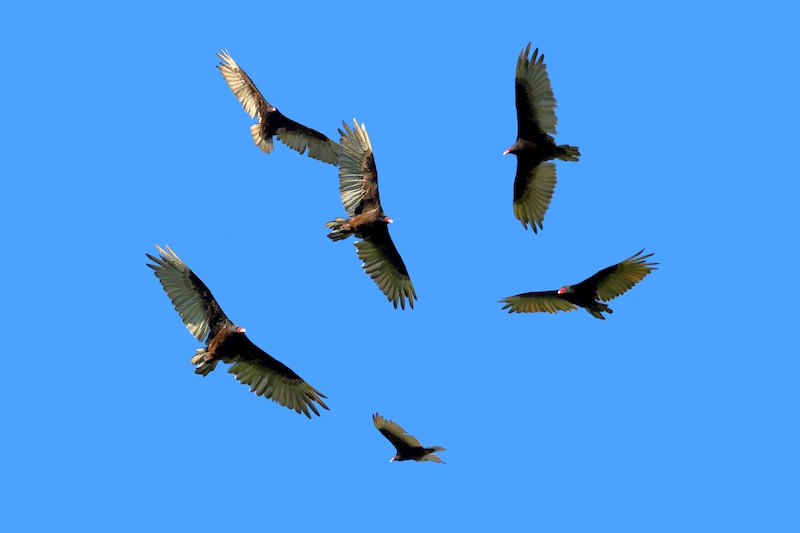
Vultures exhibit distinctive group behaviors.
A group of vultures in flight is referred to as a “kettle,” while a group resting on the ground or in trees is called a “committee.”
When feeding, the group is termed a “wake.”
Some Vultures Dye Themselves
The bearded vulture and the Egyptian vulture are unique in their behavior of “dyeing” their feathers.
They bathe in mud pools, giving their white facial and chest feathers an orange-brown hue.
The reason behind this peculiar behavior remains unclear, with several theories in circulation.
Conclusion
I hope you learned something new about vultures, they are incredible birds and fascinating to watch if you happen to see them feasting on some roadkill.
If you want to enjoy learning interesting facts about birds, check out my articles on fun facts about hawks, or what makes the great blue heron so interesting.
And, if you want to learn about photographing birds, check out my comprehensive article on getting started with bird photography.