


The great blue heron (Ardea herodias) is a fascinating bird known for its relatively large size, striking appearance, and exceptional fishing abilities.
These birds are a joy to watch and surprisingly easy to photograph because they tend to stay very still.
If you are a fan of great blue herons like I am, keep reading because I’ve gathered the most interesting facts about these long-legged birds.
What Makes Great Blue Herons So Interesting?

1. Collective Noun
A group of herons, including great blue herons, is called a siege, or sometimes a sedge. The Book of St Albans (published in 1486) used the term sege to refer to a group of herons, but later texts used sedge and present-day texts use siege.
The idea is that herons lay siege on their prey, waiting for it to surrender.
Personally, I think a persevering of herons would be a more fitting name given how patient these birds are when hunting, but the established term for a group of herons is a siege.
2. Size and Weight
The great blue heron is the largest heron in North America, achieving a height between 3-4.5 feet (92-137 cm), with a wingspan that can reach over 6 feet (about 185 cm).
Despite their large size, they only weigh between 5-6 pounds (2.27-2.72 kg), thanks to their hollow bones, a feature shared by all birds.
3. Location
Great blue herons are common year-round throughout much of North America but are also found in Central America and northern parts of South America (during winter).
4. Close Relatives

Great blue herons are closely related to grey herons (Ardea cinerea), which have similar plumage but a slightly lighter gray neck and white flanks instead of tan (right above their legs).
Grey herons are also smaller, weighing between 2.2-4.6 pounds (1.02-2.08 kg) and are most commonly found in Europe, Asia, and Africa.
5. Doppelganger
The great blue heron has a white counterpart.
The “great white heron,” likely a subspecies, lives in Southern Florida, the Yucatan Peninsula, and in the Caribbean.
In areas where great blue herons and great white herons overlap, offspring with blue heron bodies and white heads and necks can be found, these are known as “Wurdemann’s herons.”
6. Expert Fishers and Hunters

Great blue herons are excellent at catching fish and other prey; often standing motionless for long periods of time near the water’s edge, waiting for their next meal to come within striking distance of their long, spear-like bill.
7. Varied Diet
The great blue heron’s diet mostly consists of fish, but will gladly eat frogs, salamanders, turtles, snakes, insects, rodents, and even small birds.
8. Backyards
Great blue herons are not typically backyard birds unless you live near a body of water like a creek or a pond.
These birds will gladly eat your goldfish and koi fish if your pond is too shallow or lacks hiding places for the fish (I’ve seen one fishing in my backyard pond).
9. Sounds
The great blue heron’s voice is surprisingly guttural, and somehow reminds me of an elephant.
Hear the various calls and sounds made by great blue herons on All About Birds.
10. Nesting
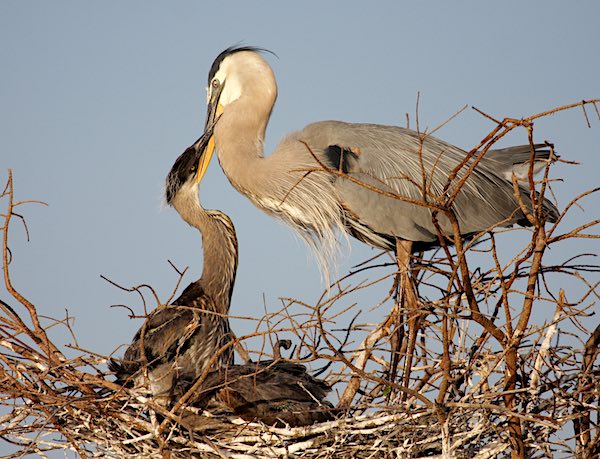
They primarily nest in colonies called “heronries” in trees near water.
These nests can be 100 or more feet off the ground and range from about five to five hundred nests per colony.
11. Anti-Slime Feathers
Great blue herons have specialized feathers on their chest that grow continuously and fray into bits of down.
They comb and preen these fraying bits of down into their feathers, providing some protection from fish slime.
12. Habitat

Great blue herons are frequently found near wetland habitats across North America as well as along the coast, and occasionally in wooded areas and open grasslands (especially if a body of water is nearby).
13. Breeding Plumage
During breeding season, great blue herons display bright blue lores, reddish irises, and orange-hued yellow bills.
14. Parenting
Both parents help incubate eggs for about four weeks and care for nestlings, which fledge at around two months.
15. Cooling Mechanisms
To keep cool in hot weather, great blue herons can be seen with drooped wings and open beaks, fluttering their throat muscles in a process called “gular fluttering.”
16. Flight Characteristics

These birds fly with their necks tucked against their bodies in an “S” shape, differentiating them from cranes, which fly with outstretched necks.
17. Night Vision
Great blue herons hunt well at dusk and in low light, thanks to a high percentage of rod-type photoreceptors in their eyes that improve night vision.
18. Age
The oldest recorded great blue heron reached at least 24.5 years old and was found in Texas.
Conclusion
Great blue herons are magnificent birds and one of my favorites to watch and photograph. Whether wading through shallow waters or soaring through the sky, these birds are incredibly interesting and I highly recommend you stop and observe one the next time you see one.
If you enjoy learning about fascinating birds, read my article on why pelicans are interesting (their pouches are just the start).
Sources
https://www.allaboutbirds.org/guide/Great_Blue_Heron/overview#
https://www.discoverwildlife.com/animal-facts/birds/facts-about-great-blue-herons/
https://seattleaudubon.org/learn/birds-of-wa/bird-facts/great-blue-heron/